Fusinpaiboon and Jang focused on improving the general conditions of Thai shophouses, one of the most common and old building types in Thailand, through renovation. This is the first part of our study identifying daylight conditions of typical Thai shophouses.
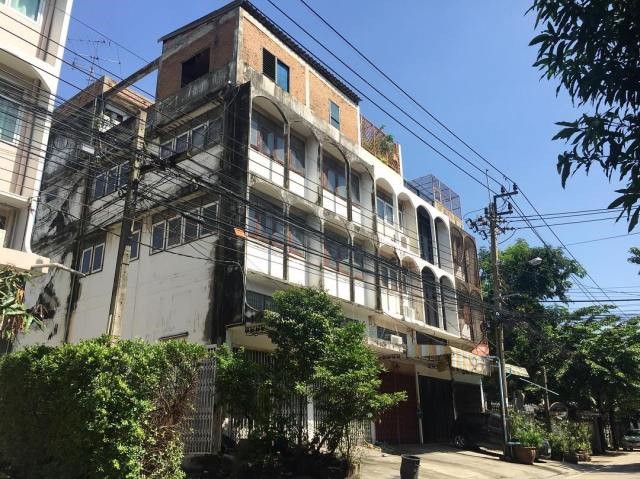
Adverse Daylight Access in Typical Thai Shophouses
Shophouses are commonly recognised by it’s narrow and long floor plan (width: 4m and depth: 12m). The twelve-meter long party walls do not allow having any opening if each shophouse unit has different owners each other. This constrains limited areas that can be exposed to outside. This limited facade area has been constrained for the house to receive enough daylight. Roughly speaking, indoor spaces within 5m or 6m from the facade can receive daylight, which are under the half of the floor plane. For this reason, adverse daylight conditions of Thai shophouse is usually inferred from the narrow floor plan and limited façade areas exposed to outside. In other words, the remained area always needs artificial lighting.
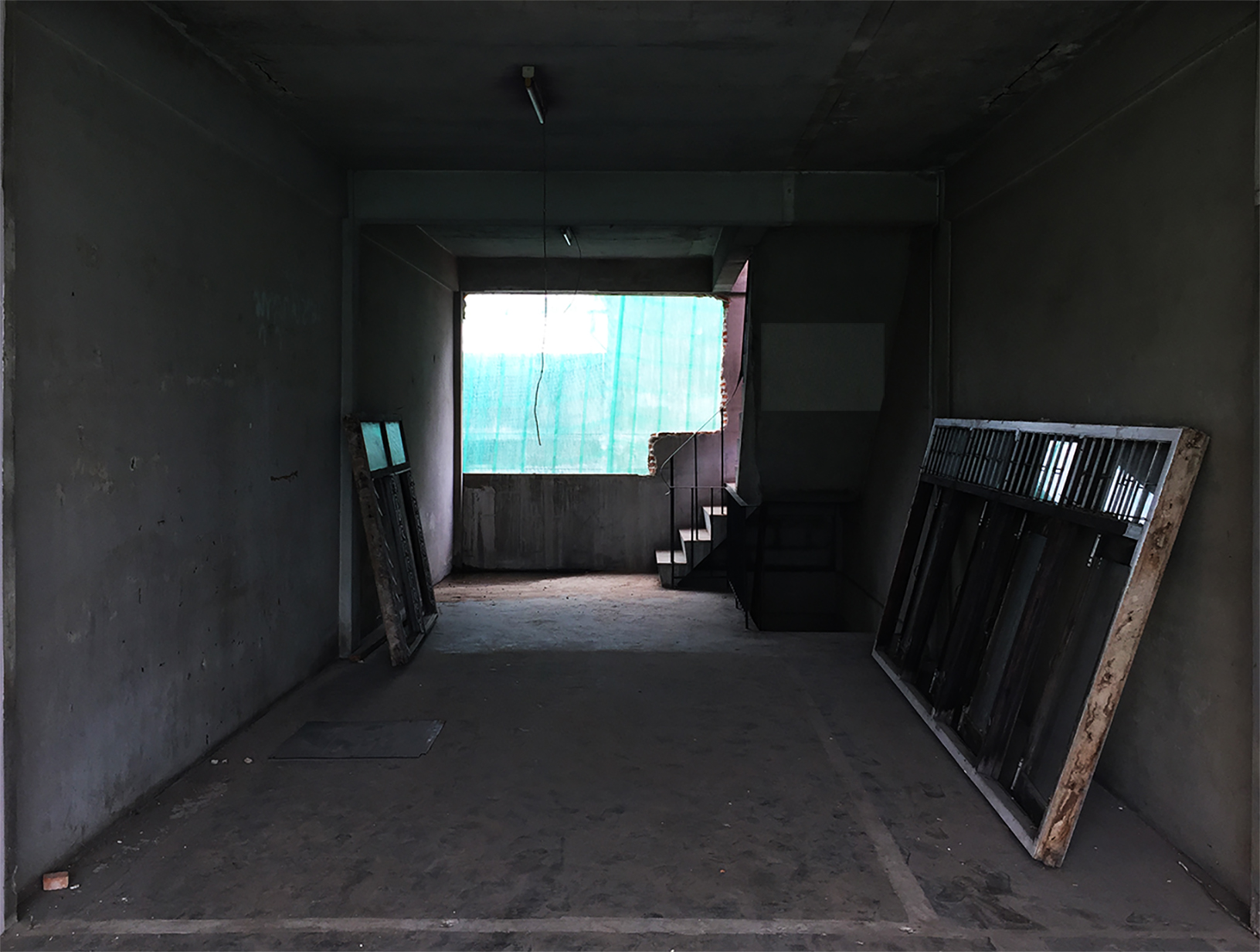
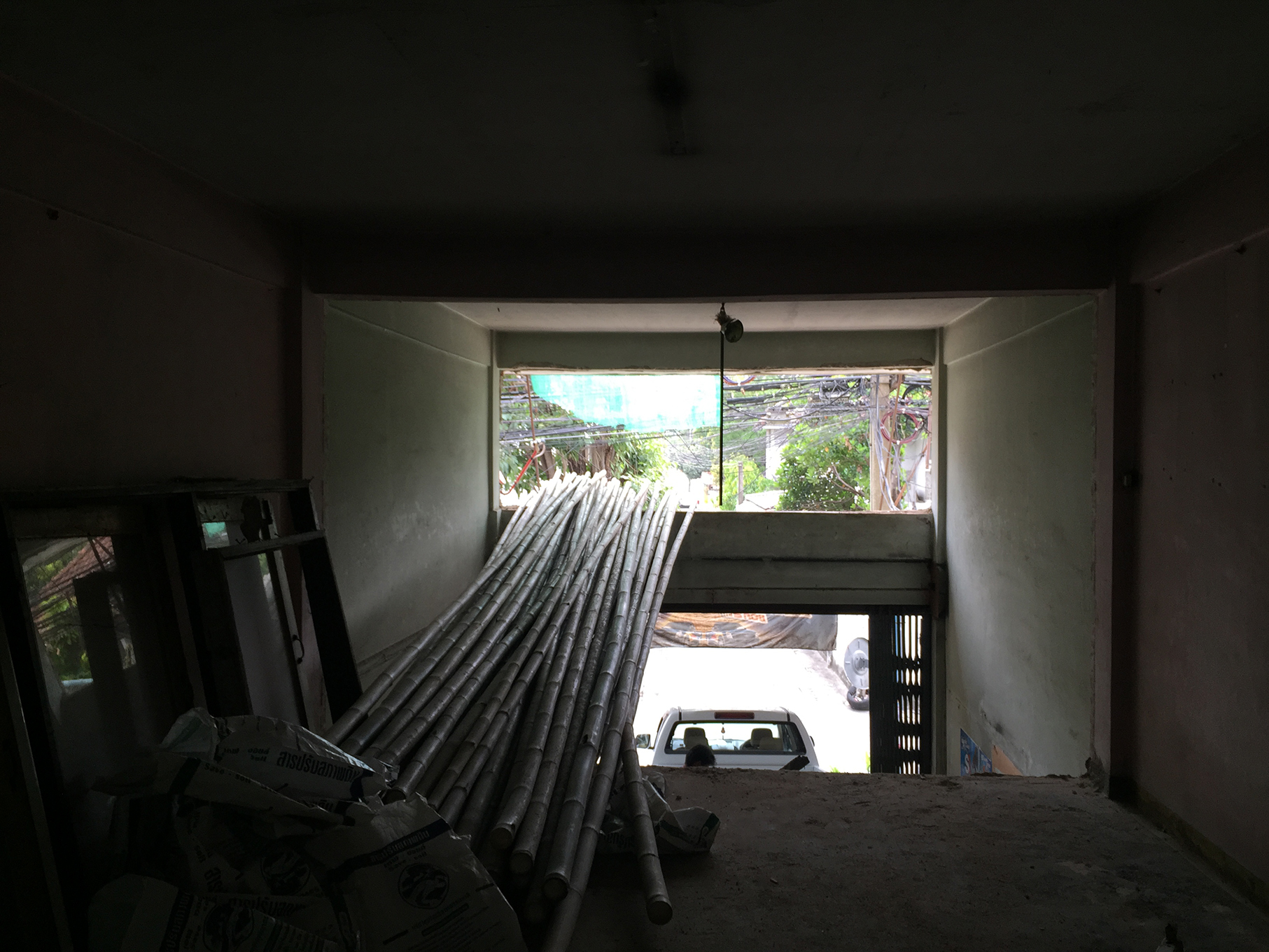
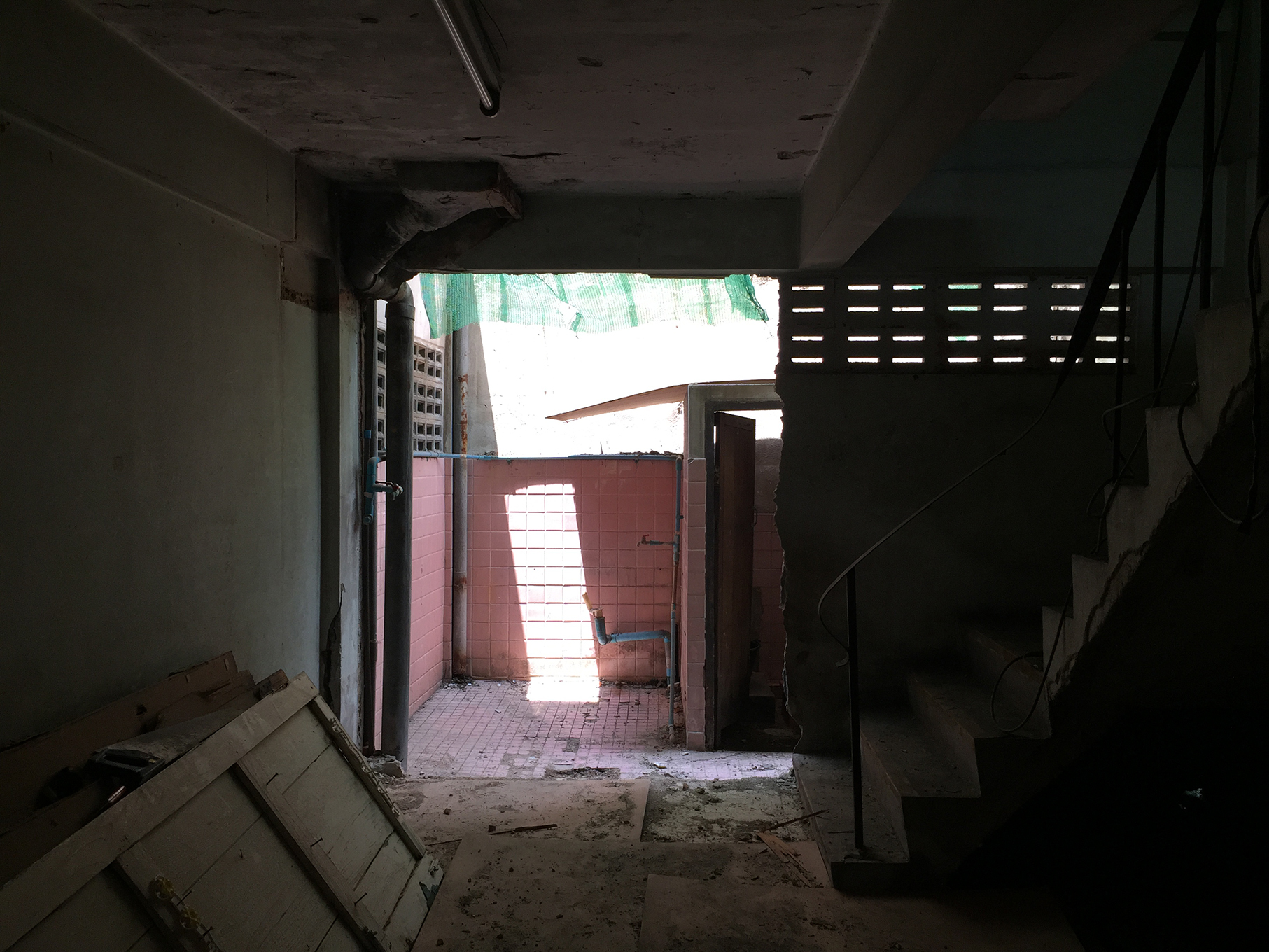
Daylight Analyses of Typical Thai Shophouses
“Daylight” is one of the inevitable issues in green building assessment certifications such as LEED, WELL, BREEAM and TREES. All the assessment certifications give the same question that is about buildings acquiring enough daylight during occupied periods. Three parameters are questioned in examining daylight conditions as below:
- Illuminance levels as per space types
- % of occupied spaces satisfying the minimum illuminance levels
- % of occupied periods satisfying the minimum illuminance levels
Three methods have been applied to analyse daylight conditions in buildings: 1) Daylight factor; 2) Illuminance Levels; 3) Daylight autonomy. Daylight factor has been used in BREEAM and TREES, while illuminance levels and daylight autonomy are taken for LEED, WELL, GREENMARK and BREEAM.
1) Daylight Factor
Daylight factor method typically identifies the horizontal work plane illumination of indoor divided by the horizontal illumination on the roof of the building an overcast sky when the sky is completely covered by clouds. Daylight factor under 2% means that the conditions are not adequately lit so that artificial lighting is necessary in spaces. Between 2% and 5% demonstrates adequately lit so that needs for artificial lighting can be minimised. Over 5% is not expected to use artificial lighting. However, the condition can cause glare issues due to excessive illumination. The method is relatively convenient to quickly detect daylight conditions. However, it is limited to calculate only with the overcast sky condition so that the method does not take various climate conditions into account the analysis. Besides, the higher % does not always mean daylight conditions are adequately lit due to glare issues.
For residential buildings located in latitude lower than 40˚, BREEAM requires 1.5% of daylight factor for kitchen and 1.2 % of daylight factor for other living areas including living rooms, study rooms, and home offices. If more than 80 % of the space complies with these thresholds, BREEAM grants 2 credits for the project. Regardless of space types, 2% of daylight factor shall be required to comply with TREES, based on Thailand. Up to 3 or 4 points can be achieved if the projects achieve more than 45 %.
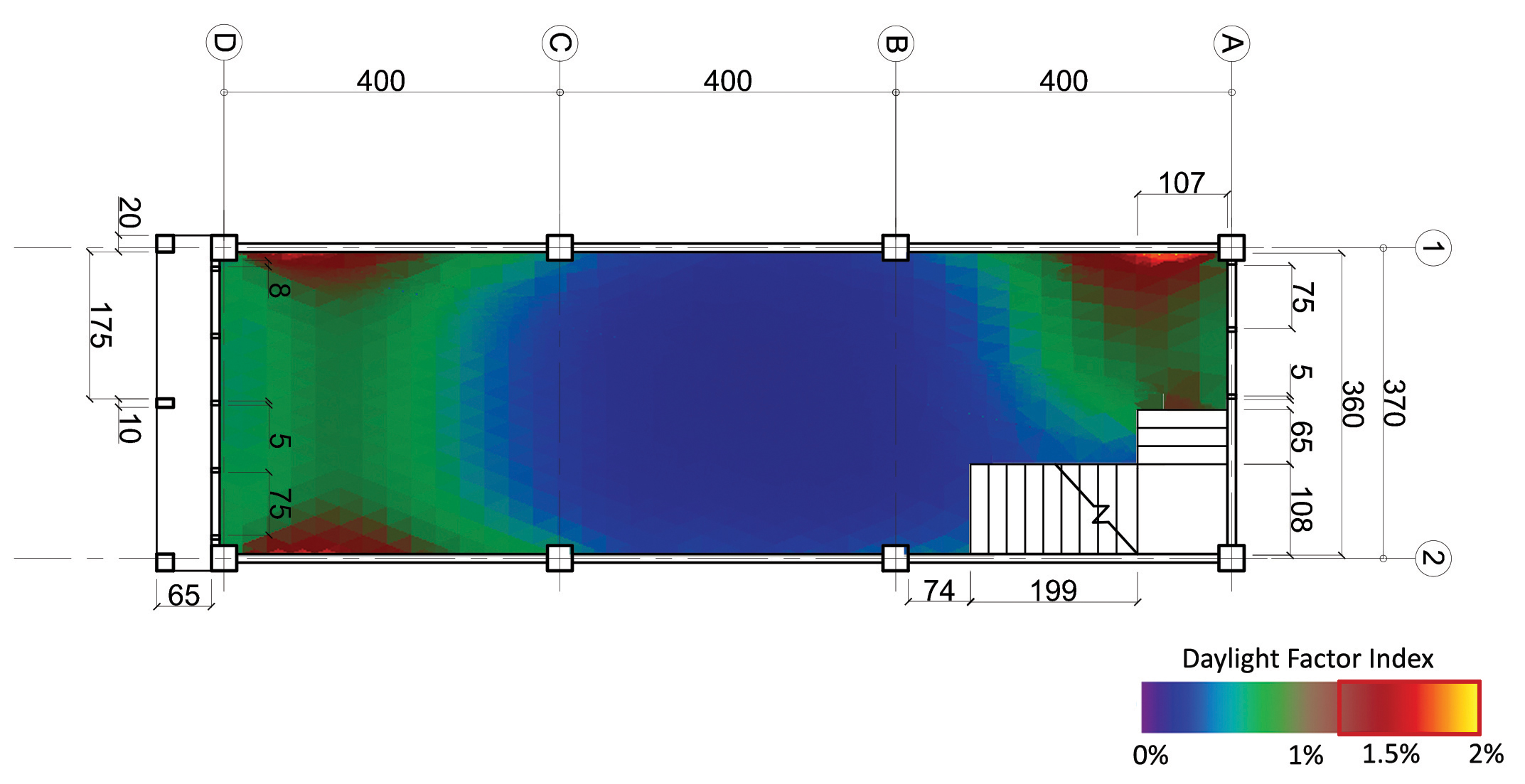
Figure 2 is the result of daylight factor with the typical Thai shop house floor plan when the main facade facing the East. The overall result demonstrates severely insufficient daylight access of the typical Thai shophouse plane. More than 90% of the floor area does not meet 1% of daylight factor. In other words, although the floor areas are near the openings, very limited areas (6 – 7%) only sufficed the daylight factor more than 1.2 %, which are the threshold of BREEAM. It is shown that this deficient result is derived from the narrow and long shape of the floor plan. As shown in blue colour in the figure above, the middle bay of the floor indicates nearly 0% daylight factor.
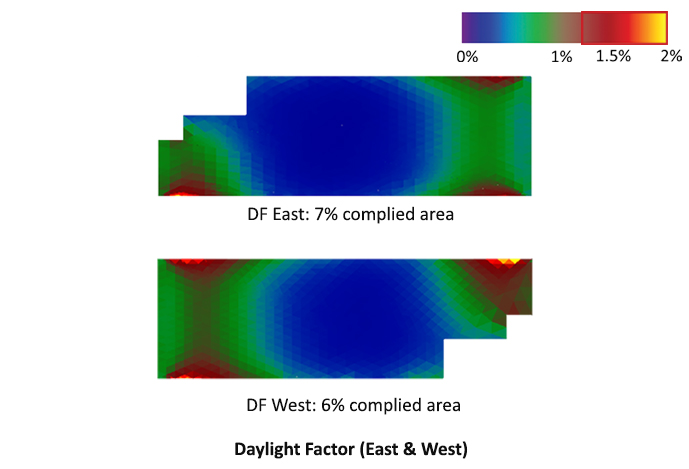
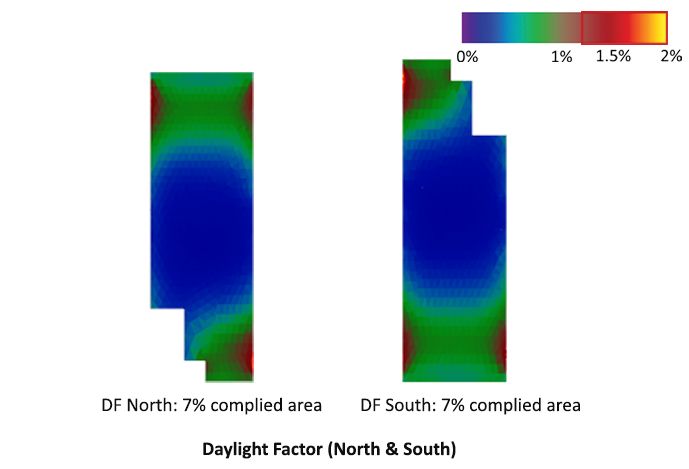
Figure above describes the results of daylight factor analysis with different building orientation. The result shows that building orientations does not give an impact on daylight assess as significant as floor plates. Regardless of building orientations, only 6 – 7% of the floor plan can outrun the threshold of 1.2%. None of spaces outrun 2% of the daylight factor, which is the requirement of TREES.
2) Illuminance Levels
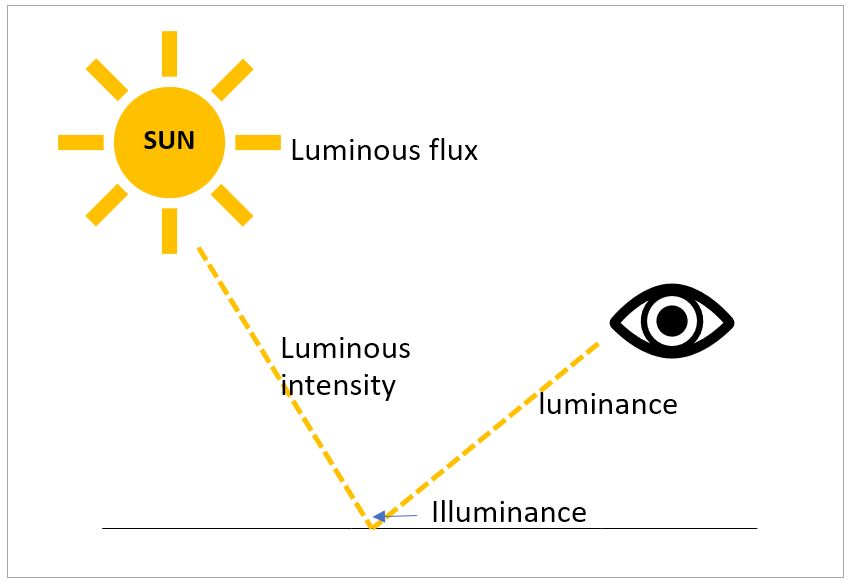
Illuminance means total luminous flux incident on a surface. It is also used to interpret daylight conditions (Figure 4). LEED has required projects achieve the minimum illuminance levels. Offices require minimum 300 lux levels while more than 150 lux is enough for residential spaces. LEED for single family house does not require the minimum illuminance levels. But, it is one of the important credits for other building types including multifamily housing, offices and commercial buildings.
LEED for multifamily housing has two illuminance requirements in the Daylight credit. At first, 90% of the regularly occupied area in residential units should meet minimum 10 lux. At second, 50% of the regularly occupied space need to meet illuminance levels between 150 lux and 5000 lux at 9 a.m. and 3 p.m. on a clear sky at the equinox when the lengths of daytime and night-time are similar each other.
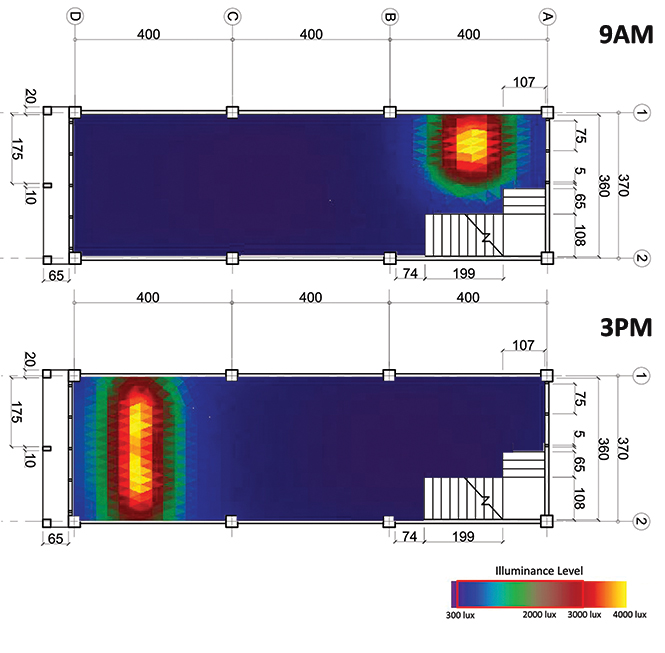
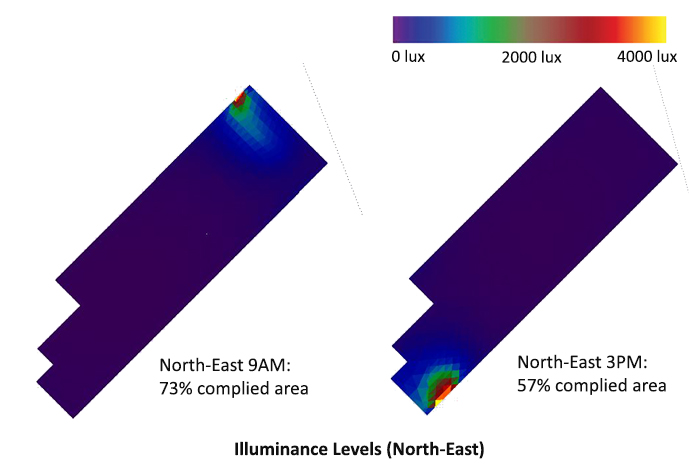
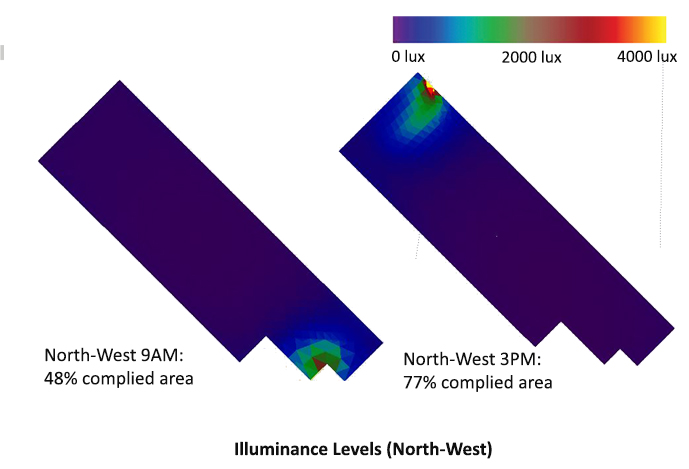
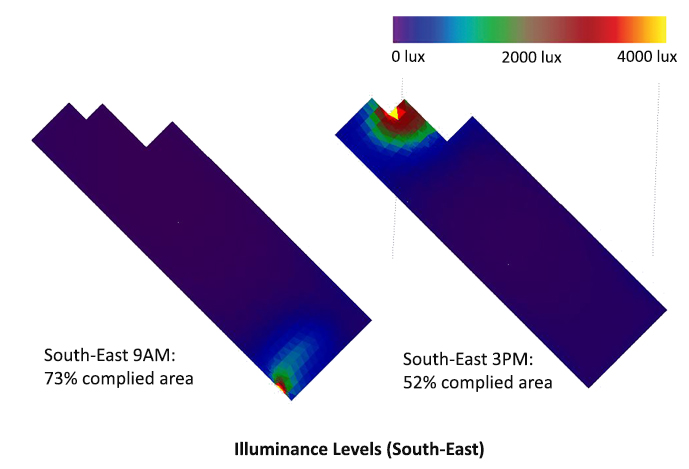
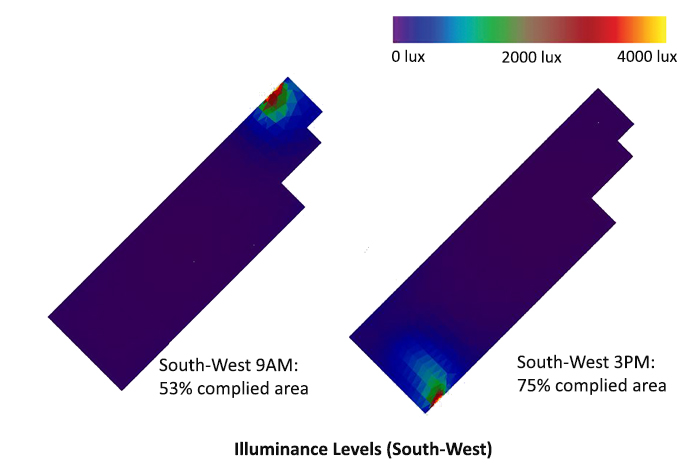
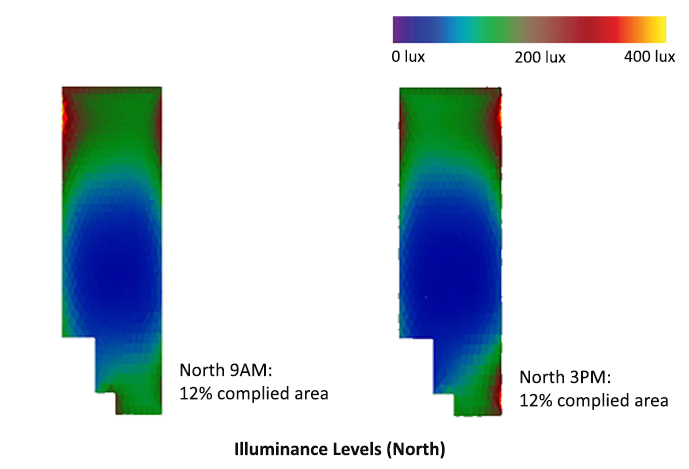
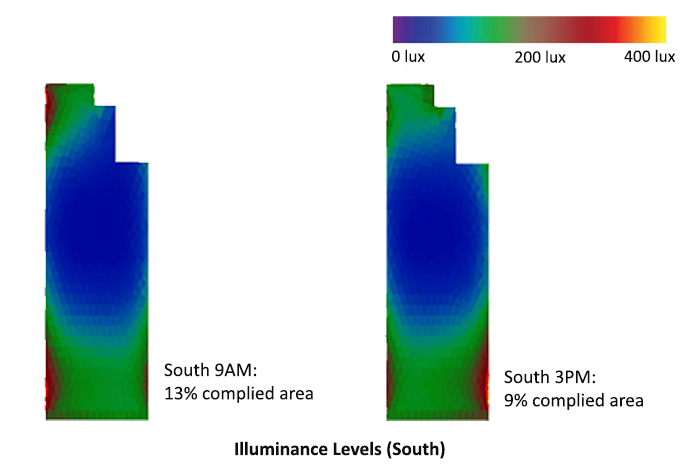
Figure 5 illustrates illuminance levels of the typical shophouse plan facing West & East. The result shows that daylight access is only available within the areas near windows. The deep inside of the floor is shown the limited daylight access, which would always need to use artificial lighting. We conducted more simulations with various building orientations. The result is explained below.
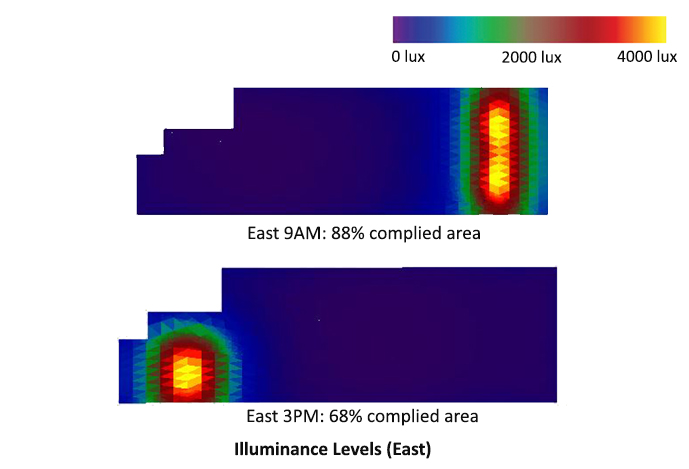
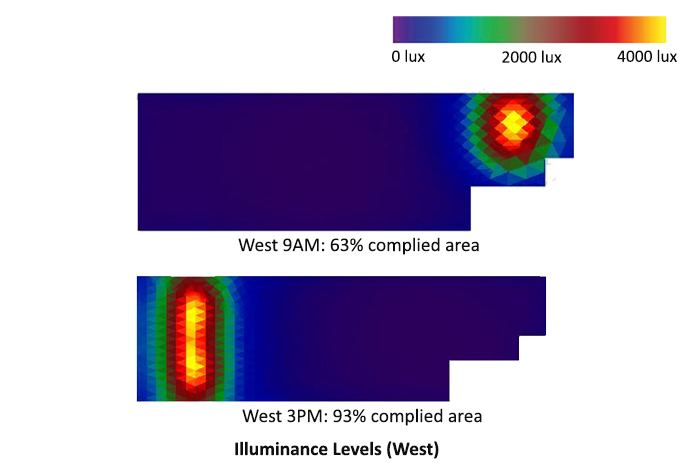
The bar graph below interprets % of floor area that complies with the minimum illuminance levels in LEED for housing (150 lux – 5000 lux), followed by the images of these results.There are still three important tendencies that needs to be considered for the building renovation.
First of all, about 50 – 90 % of the floor area can receive the sufficient illuminance levels (150 lux – 5000 lux) as per building orientations, apart from North and South facings. Although the results do not meet the requirement of the daylight credit in LEED, all-around activities at home are available with these results.
Second, the cases facing North and South especially showed low % of the complied floor areas. The result carefully needs to be interpreted. It is because the assessment method measuring at twice of a day (at 9 AM and 3 PM) does not take other times into account rather than they are relatively poor at daylight access. Actually, these two cases facing North and South also received similar daylight access to other orientations throughout the year when we looked at analysis of daylight autonomy ( ).
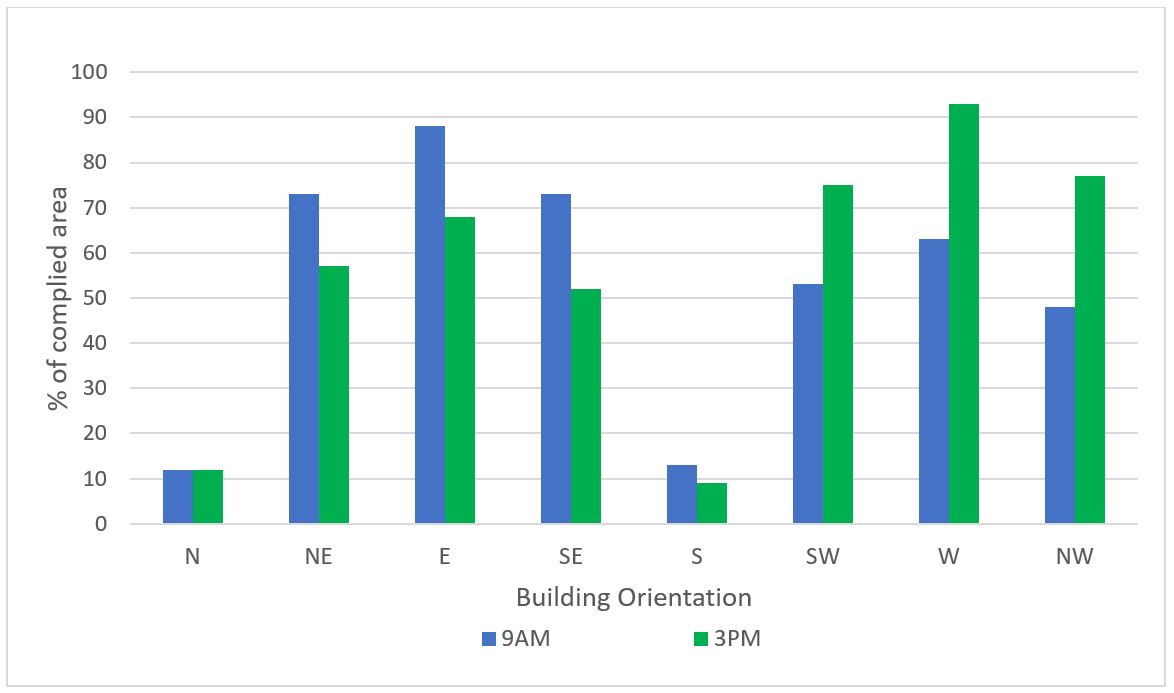
Last, the floor area with illuminance levels higher than 300 lux is very limited although whole floor area meets the minimum illuminance level to be more than 150 lux. The result makes us that space layout should be carefully designed due to the unequal daylight distribution on the floor. Depending on types of activities, different illuminance levels are required. For instance, the minimum illuminance level for living rooms is around 150 lux. However, if reading a book in the living room, the minimum illuminance increase by 300 lux. This can be solved by having an additional stnad-alone lamps, but this solution could consume additional electricity. For this reason, planning should sort out activities requiring higher illuminance levels. These functions would be placed near window areas to minimise uses of artificial lighting.
3) Daylight Autonomy
Daylight autonomy method uses climate data to evaluate daylight conditions. Using the climate data hourly-based benefits to demonstrate daylight qualities hour-by-hour throughout the year. For this reason, the analyse can be more informative than the daylight factor and illuminance levels at equinox that copes with the worst-case scenarios. Particularly, daylight autonomy examines two daylight conditions: Solar Daylight Autonomy (sDA) and Annual Sun Exposure (ASE). sDA analyses whether the designated spaces acquire the minimum illuminance levels, commonly 300 lux, for 50% of occupied hours, while ASE evaluates excessive illuminance levels that may cause visual discomfort and increase cooling loads. Additionally, Useful Daylight Illuminance (UDI) also utilises daylight autonomy but sort out the hourly results by different categories as below.
- UDI-fell short: illuminance level less than 100 lux
- UDI-supplementary: illuminance level between 100 lux and 300 lux
- UDI-autonomous: illuminance level between 300 lux and 3000 lux
- UDI-exceeded: illuminance level higher than 3000 lux
Three green building assessment certifications use the daylight autonomy method: WELL, LEED BD+C and GREENMARK. WELL and LEED uses sDA and ASE methods while GREENMARK takes sDA and UDI-e. The detailed requirements are slightly different as summarised in Table 1.

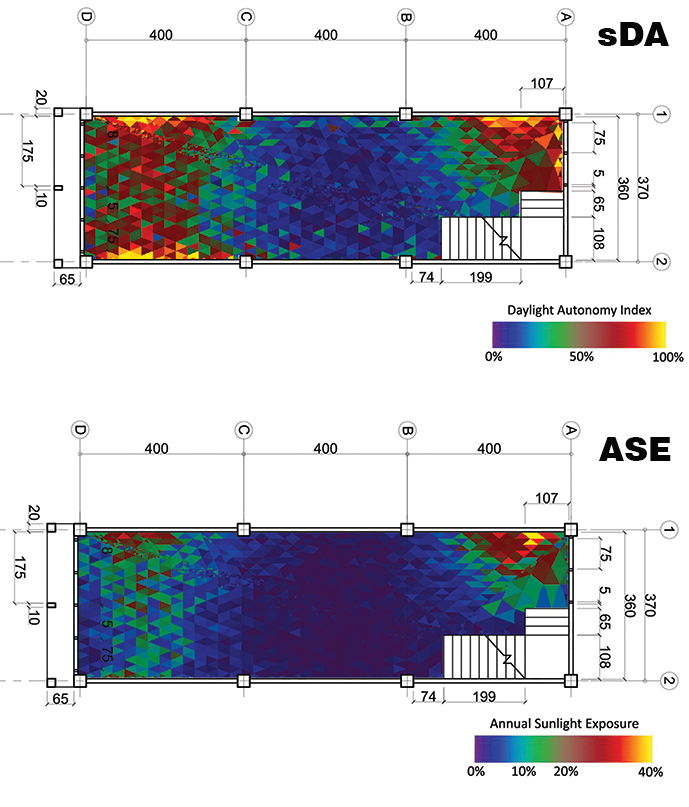
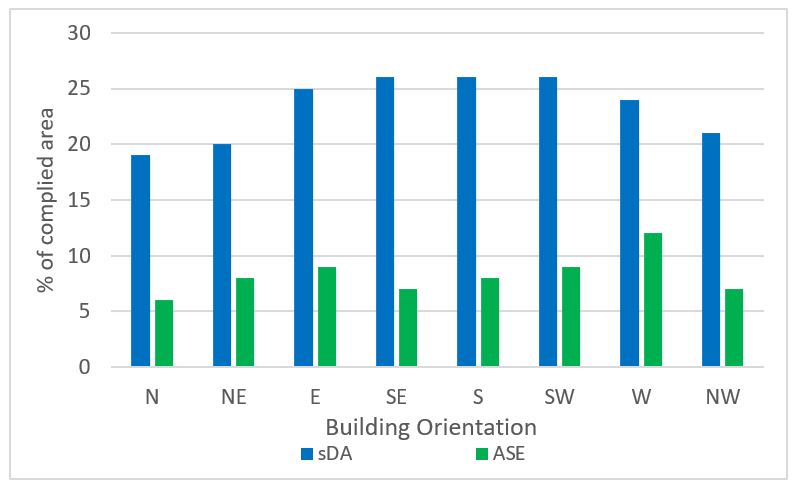
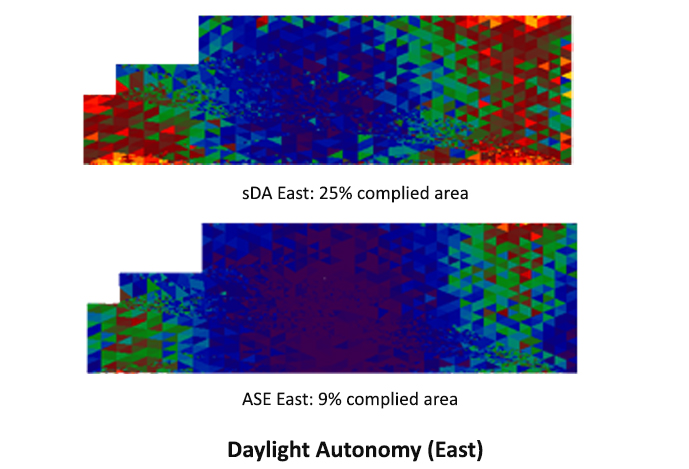
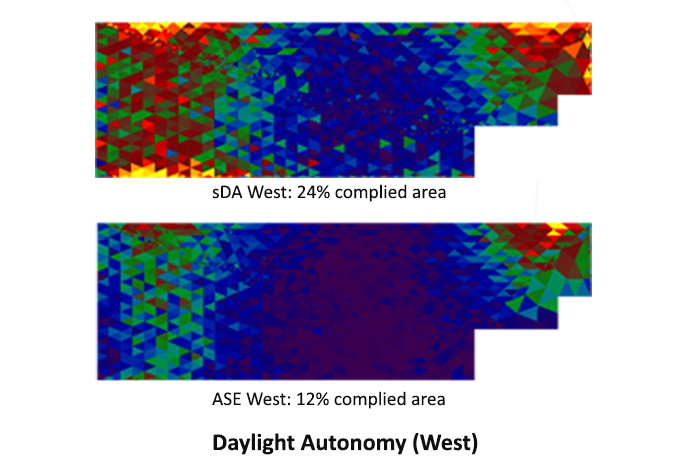
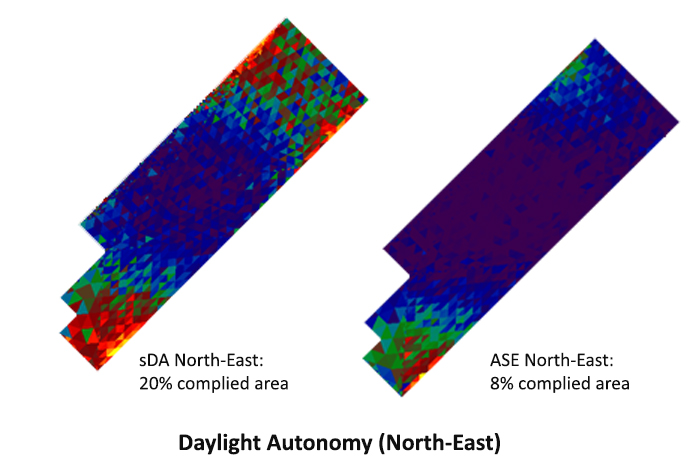
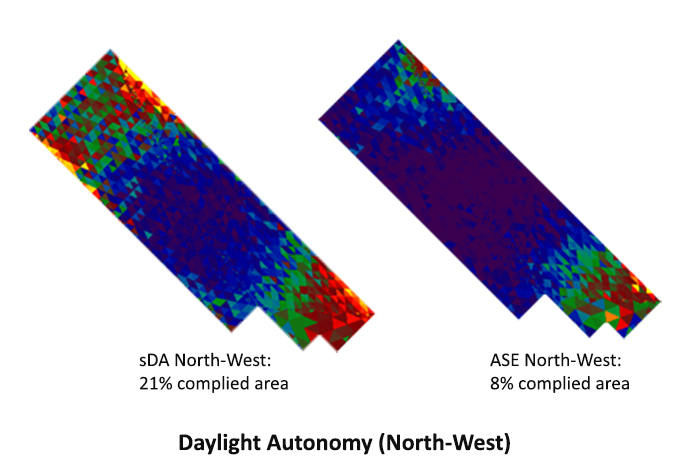
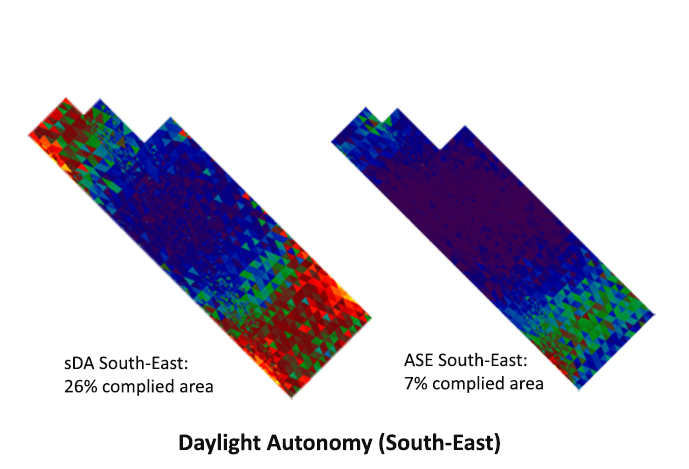
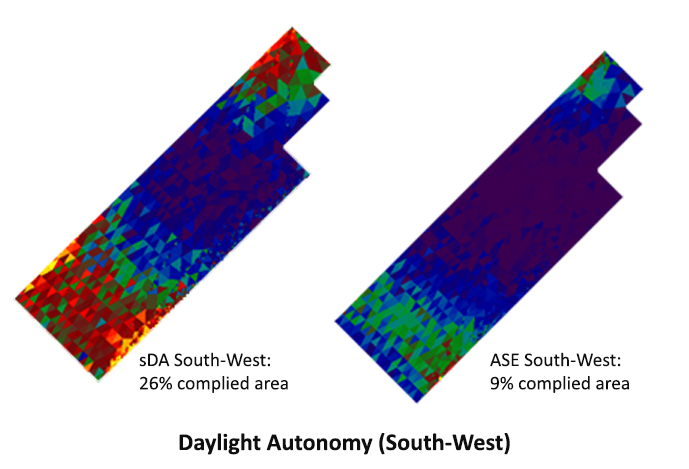
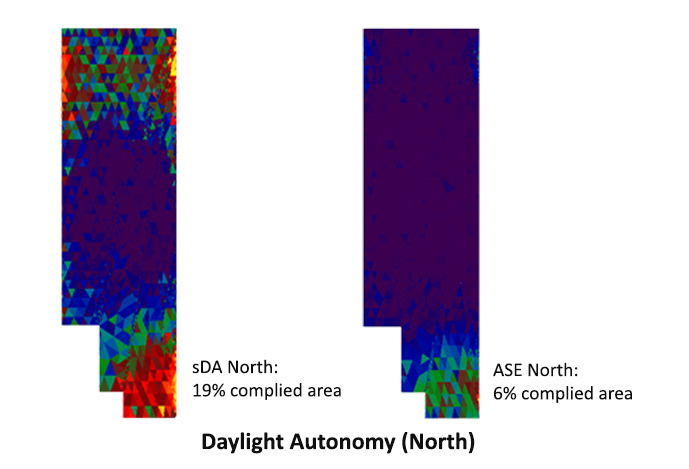
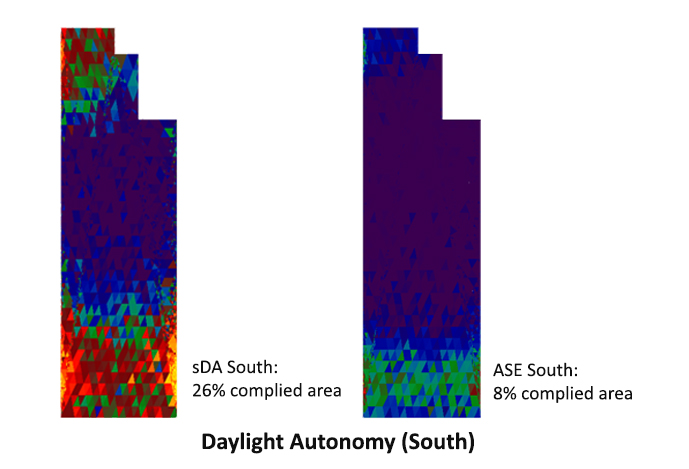
Figure 7 illustrates the result of sDA and ASE, while Figure 8 surmises describe the result of sDA and ASE with various building orientations.
The result of sDA (upper image in Figure 7) indicates % of occupancy hours that meet the minimum illuminance levels (300 lux). If the floor area achieves more than 50% of occupancy hours with at least 300 lux, LEED and WELL consider the area complies with the daylight requirement. if the complied floor area is more than 40% and 55%, these two green building certification respectively grant a point.
As shown in Figure 7, the complied area coloured with red and yellow does not reach more than 50%. Only 18 – 27% of the floor area can meet the threshold of sDA (Figure 8). The floor area within 2 – 2.5 m from the façade exposed to outside can have the minimum daylight, while the floor area in the middle bay can receive critically low illuminance levels for the limited time period. As same as the results of the illuminance analyses, these results of sDA demonstrate that 18 – 27% of the floor area provide sufficient daylight to do activities required more than 300 lux such as reading and writing. However, it does not mean the other area is not appropriate for a living.
The result of ASE (lower image in Figure 7) indicates % of occupancy hours that do receive excessive lluminance levels (1000 lux). If the floor area does not receive the excessive illuminance levels (1000 lux) more than 250 occupancy hours, LEED and WELL consider the area complies with the daylight requirement. if the non-complied floor area is less than 10%, these two green building certification respectively grant a point.
As shown in Figure 8, most of the building orientations does not exceed 10% of the floor areas. Only the case facing the West shows 12% of the floor area, which is slightly exceeded than the recommended threshold, 10%. The results indicate the floor plan of Thai shophouses overall do not have an issue with excessive daylight such as glare. This could be supported by facade shading about 0.4 m which Thai shophouses usually have.
Conclusion
This study analysed daylight conditions of the typical Thai shophouse floor plan for energy-efficient renovation. Three methods were applied in analysing the daylight access: daylight factor, illuminance level and daylight autonomy. As the methods differently looks into the daylight conditions, the results of all methods delivered various daylight conditions of the Thai shophouses.
Firstly, the analysis of daylight factor let us know that the narrow and deep floor plan can poorly receive daylight on cloudy days. This fact should be sensitively considered as Thailand has a long rainy season for 6 months. However, it should be noted that the result does not mean not enough daylight all the time.
Secondly, the illuminance analysis demonstrated that the entire floor can receive sufficient daylight for a living. However, depending on the types of activities, space planning should be carefully made as the illuminance levels higher than 300 lux is dramatically reduced 3 m away from the facade. Otherwise, supplementary artificial lighting would be needed.
Thridly, daylight autonomy informed us that the floor plan would not have issues by excessive daylight throughout the year. However, only limited area can provide sufficient daylight during occupied period. As same as the result of the illuminance analysis, each space should be laid out with the consideration of the required brightness.
Lastly, building orientation does not give an influence as significant as the floor shape does. The difference of the daylight conditions through the various orientation was limited in 10 %, according to the daylight autonomy analysis. Despite it, south and south- facing orientations are relatively beneficial to receive more amount of daylight.
 DRFJ
DRFJ 