2021
Hyunju Jang conducted a measurement study of a typical shophouse, built in Bangkok in the late-1970s, to identify the existing environmental factors of the house.
Thermal Comfort – Air temperature
Thermal comfort is defined by the comfort zones in which people are most at ease. In these zones, thermal balance in the body is maintained despite differing physiological influences from the environment. Many factors influence comfort, and it is impossible to establish definitive comfort boundaries. Rather, comfort is the product of the interaction between various influencing factors.
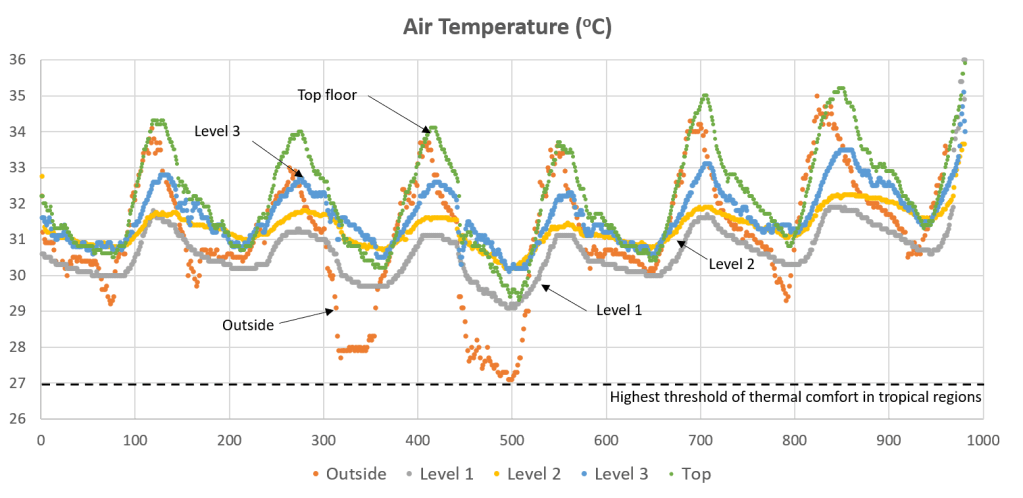
Air temperature is one of the most decisive factors of thermal comfort. It should be ideally range between 20 ◦C and 24 ◦C. In tropical regions, with human’s adaptability of thermal comfort, the range could be extended by 27 ◦C. The measurement work was executed for a month in June. The figure below illustrates the existing thermal conditions of Bangchak shophouse.
During the measurement, the outside temperature changed from 27 ◦C to 35 ◦C while indoor air temperatures fluctuated between 29 ◦C and 35. In other words, the envelope of Bangchak house functions to reduce the temperature fluctuation of indoor spaces from 8 ◦C to 6 ◦C. However, indoor thermal conditions of Bangchak house always exceed the highest threshold of air temperature in tropical regions (27 ◦C), which means that the existing envelope does not create thermal comfort without air conditioning.
There was a temperature difference between the lower and upper floors. Indoor temperatures of the upper floors, Level 1 and Level 2, were fluctuated between 29 ◦C and 32.5 ◦C, which had 3.5 ◦C of the indoor temperature difference. This range is relatively smaller than outside even though the temperatures exceed 27 ◦C. This means that these two levels can easily manage consistent indoor thermal performance with air-conditioning.
In contrast, indoor temperatures of the upper floors, Level 3 and Top-level, shows much larger ranges of indoor temperature changes. Especially, the top floor changed indoor temperatures from 27 ◦C to 36 ◦C. The reason for this temperature difference is presumably by stack effect and solar radiation on the roof. In that sense, improving the thermal performance of the existing envelope is essentially required.
External Noise Intrusion
All spaces have some degree of ambient background noise from HVAC equipment, exterior sources (e.g., traffic, outdoor equipment, pedestrians) or other building services. When the sum of these noise sources exceeds comfortable levels, space may not function as intended. According to WELL building standard, average background noise levels in dwelling units when measured over a 12-hour minimum time period, do not exceed 35 dBA.
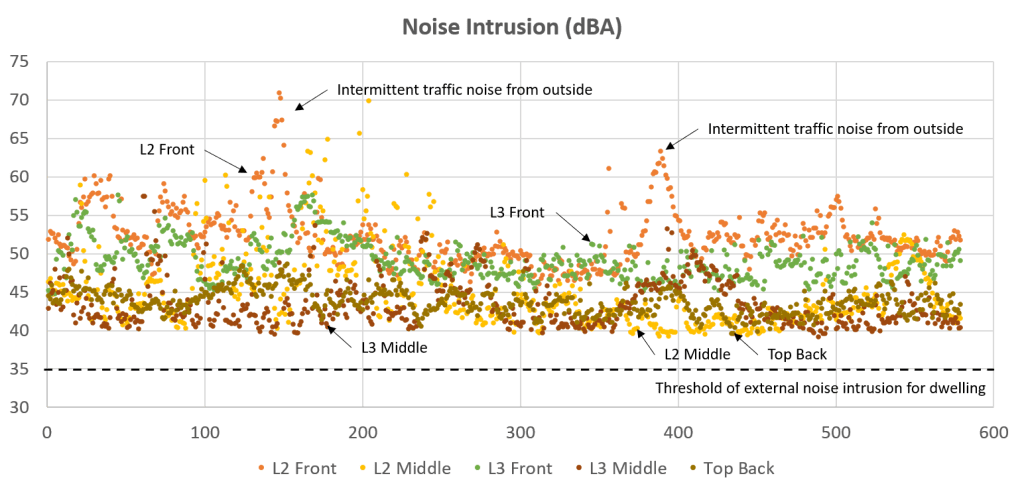
Our noise measurement was conducted for half of an hour on a weekend in June. Although our measurement work was not conducted over a 12-hour time period, the result illustrates uncomfortable acoustic conditions of the existing spaces.
As the figure describes, front bays on Level 2 and 3 are exposed to more serious noise issues. Average noise levels of both floors are respectively 52 dBA and 49 dBA, which is much higher than the recommended threshold, 35 dBA. On top of that, intermittent traffic noises, mostly derived from bypassing motorbikes, frequently reaches to 60 dBA and even 70 dBA. For this reason, renovation strategies require to prescribe maximum thresholds for ambient background noise that correspond to optimal levels of exterior noise exposure.
 DRFJ
DRFJ 